

This telescope, created by ZWO has without doubt taken the astronomy and astrophotography market by storm.
Created by the Chinese company, ZWO, the same ones who developed the spin-off from the ASIAir Pro and +, it’s clear they wanted to distil their expertise into something that took much of the pain out of astronomy.
As seasoned Amateur Astronomers ourselves we are well aware of the pain of levelling, polar alignment, and balancing problems. Any of which, if not done right can cause problems.
The ASIAir was launched it took a lot of the problems away. Its ability to aid with Polar Alignment and to platesolve (that’s when you’re telescope moves to an object but misses it, so it takes an image of where it is and works out from that where it needs to be). The ASIAir also meant that there was no longer need to have an expensive laptop left out in the freezing cold.
So, clearly ZWO wanted to build a telescope, a smart one at that, which could be used by the beginner.
As an organisation working with young and old on our SpaceKidets and GCSE Astronomy programs, we wanted something we could setup and let people remote in to enjoy, up until then we relied on our existing setups which tbh too more pain to setup and get working properly meaning we ran out of time to stream. Also the fact many clear nights followed a downpour. Can’t setup in that!
After various high profile astronomers started to report their successes with the telescope, we decided to take the (albeit, expensive) plunge.
Firstly, this isnt the kind of telescope to replace an expensive setup. Maybe one is coming, but for seasoned astronomers with top end kit, this isn’t for you!
But to put a telescope out there (we plonk ours on a garden table) there maybe a little adjustment needed for levelling, but not much. Then away we go.
I was extremely skeptical at first, after all, why should this telescope find anything? So, first target was a daytime object, the Sun.
NOW, this is where we need to be careful as the solar filter it comes with, should be installed first, so you are going to need to get it to open somehow (cannot be done when off) so this can be fitted. I send it to the Sun myself, standing in between it and the Sun, while i quickly affix the filter.
Once done, i leave it to it,….
And guess what, it finds it!

The images produced are impressive!
You can also Zoom in up to 4x and use the ring navigator and focussing panel to further enhance the experience.
Interestingly enough while it seems to find the Sun without effort, it does struggle somewhat with the Moon but with patience you can align. The below for example took some work to manually obtain it, but i understand there is a bug causing this. Worth remembering too, if you’ve accidentally left the solar filter on then this is also going to cause problems 

Deep sky work is also impressive, it has an inbuilt database and can take integration shots at 10, 20, and 30 sec exposures. This may not sound much to the seasoned Astrophotographer, but it is nice to see the images improve before your eyes!
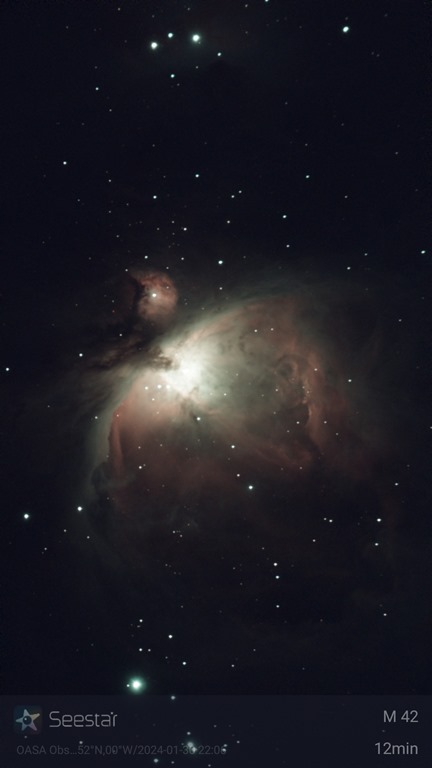
The telescope software allows for real time stacking as you work. It is an impressive piece of kit when you consider the quality of the images you get from it.
I was also pleasantly surprised to see i could scroll through images and email them to myself. They are jpg format though, but RAW, TIFF, would be massive
Sadly, at the time of writing this, remote working isnt really built in. Like you can use BlueStacks to remote into ASIAir or even your tablet device using the app you cannot use that here.
SeeStars needs the bluetooth to work, this is where BlueStacks will fail to work. There are workarounds though i will discuss in another blog post, but know that to operate this you will need a mobile device, phone or tablet.
I think people who would be interested in this would be
Teachers looking for a quick and simple device to setup during day time
Ourteachers who need something relatively easy to pack and travel with
People with limited space for a telescope
Its also light and small enough to take on holiday, a bonus in that it comes with its own case.
Downsides are
While the telescope has a built in anti dew, this does draw more power. The colder it is the less time this will function. The least amount of time i have had out with it was 2 hours. You can hook it up, but i understand below –10C it no longer draws power externally.
While i do not feel this is the finished product (a bahtinov mask would have been a nice addition, along with a small finder). But for what it is, it does what it says on the tin.
also note if you want to stream this using the RTSP it will do it via the VLC player which is free to download and use. However that is only effective for lunar and solar shots. If stacking, so for DS or Planetary work it isnt going to work.
That brings me to planets
Its not bad, but not great. Then which telescope is. I could make out the equatorial bands on Jupiter with it, but couldnt manage much better.
We will blog more about this device, but in summary we will say
If you
a) are a teacher
b) Outreach Educator
c) Lack space or time for formal astronomy
d) looking for a travel companion
Then this might be for you
Otherwise if
a) You are an established astronomer with existing top end kit
b) Happy with the setup you have
c) Lack the budget (£500+ is a LOT of money for a telescope!)
Then this is not for you.
Other bonuses with this telescope, though i have not used it yet as such, is for terestrial work, looking at trees, out to see at ships, and such its good for that. So if you buy this then lose interest, its not completely useless.